
🤖 What Is AI Data Labeling? Beginner Guide 2026 (Start Today)
Last Updated: October 2026
Introduction
Artificial intelligence (AI) is used in areas such as image recognition, language processing, speech technology, and document analysis. Many AI projects use data labeling to help prepare datasets or evaluate how well a system performs.
If you are exploring beginner-friendly remote work, AI data labeling is one area worth understanding. Some companies offer paid data annotation or AI evaluation projects, but the required skills, eligibility, availability, and compensation vary.
In this guide, you will learn:
- What AI data labeling means
- How the labeling process works
- Common types of labeling tasks
- Platforms to research for potential opportunities
- Skills beginners may need
- How compensation and payment conditions work
- How to recognize warning signs of job scams
Important: This guide is for informational purposes. It does not guarantee employment, platform acceptance, task availability, or a particular income.
What Is AI Data Labeling?
AI data labeling, also called data annotation, is the process of tagging, categorizing, or adding meaningful information to data. Labels can help prepare examples for machine-learning systems or evaluate the results produced by AI models.
Data labeling can involve images, text, audio, video, documents, or other types of information.
A simple example
Imagine a dataset containing photographs of cats and dogs. A labeling task might ask a contributor to identify the animal shown in each photograph and assign the correct category.
- A photograph showing a cat receives the label “cat”.
- A photograph showing a dog receives the label “dog”.
These labeled examples may then be used in a machine-learning workflow. The exact process depends on the project, and not every AI system requires manually labeled training data.
Why Is AI Data Labeling Important?
In supervised machine learning, labeled examples help a model learn relationships between inputs and expected outputs. Labeled datasets can also support testing, evaluation, and quality assurance.
For example:
- Computer vision: Labels may identify cars, pedestrians, road signs, or other objects in images.
- Language processing: Text may be categorized by topic, intent, or sentiment.
- Speech technology: Audio may be transcribed or annotated with timestamps.
- Video analysis: Objects or activities may be identified across selected frames.
- AI evaluation: Responses may be reviewed against defined criteria for relevance, accuracy, or instruction-following.
Label quality matters. Inconsistent or incorrect annotations can reduce the usefulness of a dataset, which is why many projects provide detailed instructions and quality checks.
How AI Data Labeling Works: Step by Step
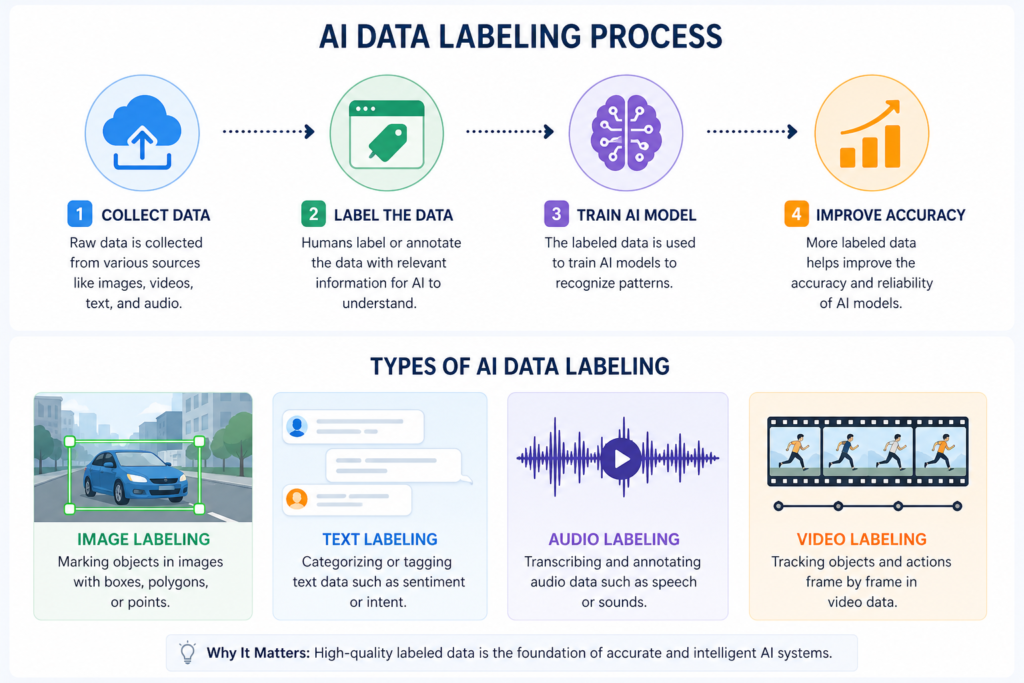
Step 1: Collect or prepare the data
A project owner prepares the material to be labeled. This may include photographs, text, audio recordings, video clips, or documents.
Step 2: Read the labeling instructions
Contributors receive guidelines that explain which labels to use, how to handle uncertain examples, and what qualifies as a correct submission.
Step 3: Label the data
The contributor applies the required labels using the platform’s interface or other approved tools. The task may involve categorizing content, drawing boxes around objects, transcribing speech, or reviewing AI responses.
Step 4: Review the work
Submissions may be checked automatically or reviewed by a human evaluator. Some projects provide feedback or allow corrections when the work does not meet their criteria.
Step 5: Use the prepared data
Depending on the project, the labeled data may support model training, testing, evaluation, or other data-quality activities. More labeled data does not automatically guarantee better AI performance; quality, relevance, and suitability also matter.
Types of AI Data Labeling Tasks
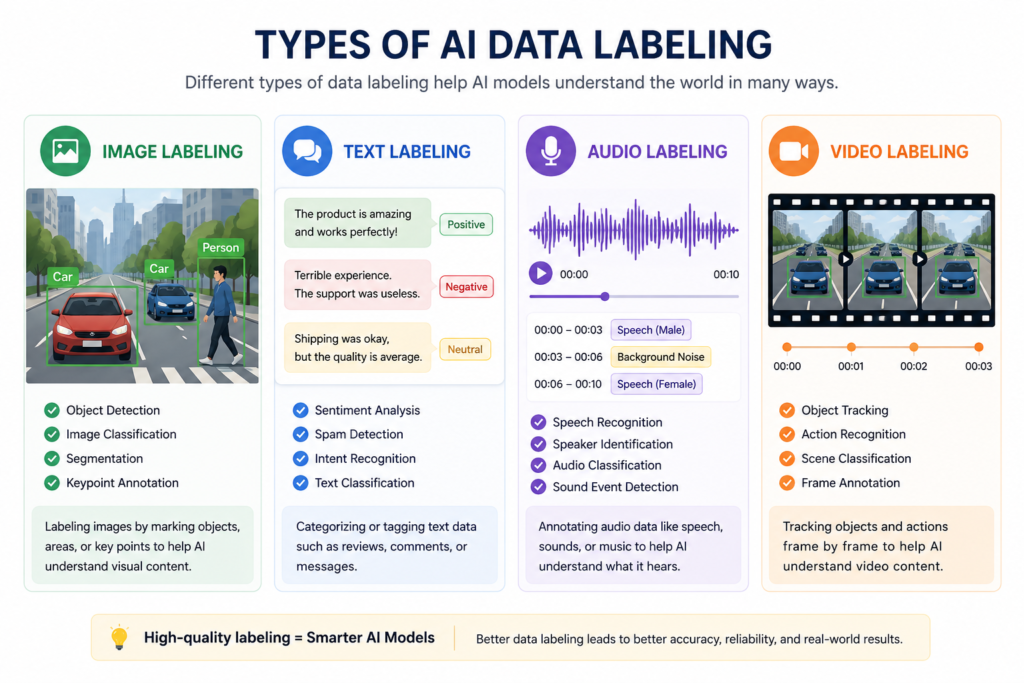
1. Image labeling
Image-labeling tasks may ask contributors to identify objects, classify photographs, mark key points, or draw bounding boxes around items such as cars, people, or animals.
Useful skills: Attention to detail, visual recognition, and consistent application of instructions.
2. Text labeling
Text-labeling tasks involve assigning categories to written content. For example, a customer message might be categorized as a billing question, a technical issue, or an account request.
Useful skills: Reading comprehension and the ability to apply category definitions consistently.
3. Sentiment analysis
Sentiment labeling involves classifying the tone or opinion expressed in a piece of text. Depending on the project, categories may include positive, negative, neutral, or more specific labels.
4. Audio labeling
Audio-related tasks may include speech transcription, speaker identification, timestamp annotation, or checking the accuracy of an existing transcript. Some projects require proficiency in a particular language.
5. Video labeling
Video annotation may involve identifying objects in selected frames, tracking movement, or marking particular activities. Some assignments require contributors to maintain consistent labels across multiple frames.
6. AI response evaluation
Some AI projects ask contributors to evaluate generated responses using defined criteria. These may include relevance, factual accuracy, clarity, completeness, or adherence to instructions. Specialist projects may require subject knowledge or technical skills.
A Practical Example of an AI Data Labeling Task
Imagine a project that asks you to identify cars in a street photograph. The project guidelines explain that each clearly visible car needs its own bounding box and that bicycles must not be labeled as cars.
| Example item | What the contributor should do |
|---|---|
| A clearly visible car | Draw a bounding box and apply the required car label. |
| A second car | Create a separate box if the instructions require individual object labels. |
| A bicycle | Do not apply the car label. |
| An unclear or partly hidden object | Follow the project’s rules for uncertain examples. |
This example illustrates the general idea. Actual interfaces, labeling criteria, and acceptance rules vary by project.
Common mistakes to avoid
- Missing objects near the edge of an image.
- Drawing boxes that exclude parts of an object.
- Confusing similar categories.
- Ignoring exceptions in the instructions.
- Guessing when the guidelines specify how to handle uncertainty.
- Prioritizing speed over accuracy.
How Much Can You Earn From AI Data Labeling?
There is no single earnings figure that applies to every AI data-labeling opportunity. Compensation depends on the platform, task type, project terms, country, qualifications, available workload, and quality requirements.
Some projects pay per accepted task, while others use hourly or project-based compensation. Qualification assessments and training may also affect the total time involved.
Example: Calculate your effective hourly rate
Suppose a project pays $12 for a completed assignment that takes two hours. Your effective rate for that task time is $6 per hour.
If you also spend one unpaid hour qualifying for the project, the effective rate across all three hours becomes $4 per hour, assuming that qualification time is unpaid.
This is an illustrative calculation, not an estimate of typical platform earnings. Actual rates and payment arrangements differ by project.
Before accepting an opportunity, check:
- Whether compensation is hourly, per task, or project-based.
- Whether payment depends on acceptance or quality review.
- Whether qualification and training time are paid.
- Which payment methods and payout thresholds apply.
- Whether transaction fees or currency-conversion charges apply.
- How much work is actually available to you.
Read our related guide: AI Data Labeling Salary Guide.
Skills Required for Beginners
Some basic data-labeling tasks do not require programming experience. However, requirements vary, and more specialized AI evaluation projects may require technical or professional expertise.
- Attention to detail: Notice differences and avoid avoidable errors.
- Reading comprehension: Understand instructions and exceptions.
- Consistency: Apply the same rules to similar examples.
- Basic computer skills: Navigate websites and use browser-based tools.
- Language proficiency: Understand the language required for the project.
- Patience: Complete repetitive tasks without overlooking details.
- Ability to learn: Use feedback to improve the quality of your work.
Some projects may require a computer, headset, microphone, or other equipment. Check the requirements before spending money on additional devices.
Related guide: AI Job Skills for Beginners.
How to Start AI Data Labeling: Step by Step
Step 1: Learn the basics
Understand the task types and decide which ones fit your current skills. You can begin by researching image annotation, text classification, transcription, or AI response evaluation.
Step 2: Research suitable platforms
Compare providers based on your country, skills, language, equipment, and preferred type of work. A platform that suits one contributor may not be suitable for another.
Use our comparison guide: Appen vs TELUS vs OneForma vs DataForce.
Step 3: Check eligibility and create an account
Visit the provider’s official website. Review its eligibility rules, application process, privacy terms, and payment conditions before registering.
Step 4: Complete any required assessments
Some projects require qualification tests, training, sample tasks, or identity verification. Follow the official instructions and use the permitted materials.
Related guide: TELUS AI Exam Tips.
Step 5: Complete tasks carefully
Read the task guidelines, apply the required criteria, and review your submission before sending it. Use available feedback to identify mistakes and improve your consistency.
Step 6: Track your results
Record time spent, submitted tasks, approvals, payment status, and any fees. This helps you assess whether the opportunity is practical for your schedule.
AI Data Labeling Platforms to Research
The following providers have been associated with data annotation, crowdsourcing, language-data projects, or AI evaluation. This is a research list, not a ranking or a guarantee that a particular platform currently has work available for you.
| Platform | What to check | Official website |
|---|---|---|
| Remotasks | Current access, eligibility, project availability, and payment terms | Remotasks |
| Toloka | Task availability, supported locations, and payout conditions | Toloka |
| Clickworker | Available tasks, assessments, and payment requirements | Clickworker |
| Appen | Current projects, contributor eligibility, and application terms | Appen |
| DataForce | Data collection, language projects, and annotation opportunities | DataForce |
| OneForma | Language, data collection, and annotation projects | OneForma |
| TELUS Digital AI Community | AI-related roles, qualifications, and location requirements | TELUS Digital |
| Outlier | AI evaluation opportunities and any specialist requirements | Outlier |
Check each provider’s official website for the latest details. Platform names are included for informational purposes and do not imply endorsement or guaranteed access to work.
Explore our platform guides
Can You Start Without Investment?
Some platforms allow free registration, but this does not mean remote work has no costs. Internet access, electricity, equipment, and other ordinary expenses may still apply.
Review the official terms before registering. Be cautious of requests for deposits, account activation fees, or payments supposedly needed to unlock guaranteed work or release earnings.
Related guide: AI Data Labeling Jobs Without Investment.
Planning a Consistent Routine
A routine can help you organize your time, but consistency alone does not guarantee tasks or income. Project availability, qualifications, quality requirements, and demand can all affect your results.
A practical routine may include:
- Checking official project updates and available tasks.
- Reviewing instructions before beginning work.
- Completing suitable tasks carefully.
- Reviewing feedback and correcting recurring mistakes.
- Tracking time, approvals, and payments.
Related guide: AI Data Labeling Daily Routine.
Common Problems Beginners Face
No tasks available
Tasks may be limited by country, project demand, qualification status, or account eligibility. Review official notices and confirm that your profile is complete.
Related guide: Toloka Not Showing Tasks: Possible Causes and Fixes.
Lower-than-expected earnings
Effective earnings may be affected by task rates, completion time, qualification time, approval rules, fees, and available workload. Track actual results instead of relying only on advertised rates.
Related guide: Ways to Improve Your AI Data Labeling Workflow.
Rejected submissions
Work may be rejected when it does not meet the project’s requirements. Review the instructions and any available feedback. Contact official support if you need clarification about a submission.
Related guide: Why You Are Not Getting AI Jobs.
How to Avoid AI Job Scams
Fraudulent job offers may imitate real companies or use convincing branding. A professional-looking website or message is not enough to establish that an opportunity is legitimate.
- Find the company’s official website independently.
- Confirm that the role or project appears through an official channel.
- Be cautious about registration fees, deposits, or payments to unlock tasks.
- Do not share passwords or one-time passcodes with recruiters.
- Read the payment rules and acceptance conditions before working.
- Verify unusual identity-check requests before sharing personal documents.
- Avoid offers that promise guaranteed income without clear, verifiable terms.
Some legitimate providers require identity verification through an official process. Always verify the website and the reason for the request before providing sensitive information.
Read our guide: AI Data Labeling Job Scams.
Is AI Data Labeling Worth Considering?
AI data labeling may be worth exploring if you are comfortable following detailed instructions, checking information carefully, and completing structured tasks. However, it is not the right fit for everyone.
Potential advantages
- Some entry-level tasks do not require programming experience.
- Some opportunities can be completed remotely.
- Tasks may help you develop experience with data quality and AI workflows.
Potential limitations
- Task availability may fluctuate.
- Some projects require assessments or specialist knowledge.
- Repetitive work may require sustained concentration.
- Payment can depend on approval and project terms.
- Income may not be predictable enough to rely on as a primary source.
Related guide: Is AI Data Labeling Worth It?.
Compare Opportunities Carefully
When comparing platforms, consider more than the advertised payment. Check eligibility, the type of work, qualification requirements, payment methods, task availability, and the time needed to complete assignments.
For a related comparison, read: Microworkers vs Toloka Earnings.
What to Do Next
If you want to explore AI data-labeling opportunities further, these guides may help you decide what to research next.
- AI Data Labeling Jobs
- Start AI Data Labeling Jobs Without Experience
- Highest-Paying AI Data Labeling Jobs
- Start Here: Remote Work Guides
- Explore All Articles
Frequently Asked Questions
1. What is AI data labeling?
AI data labeling is the process of tagging, categorizing, or annotating data such as images, text, audio, and video. The resulting labels may be used to prepare datasets or evaluate AI systems.
2. Can beginners apply for AI data labeling jobs?
Some projects accept applicants without professional experience, while others require assessments, specific language skills, technical knowledge, or specialist qualifications. Check the requirements of each opportunity.
3. Do I need coding skills?
Not necessarily. Some basic labeling tasks do not require programming, but technical AI evaluation projects may have additional requirements.
4. How much can I earn from data labeling?
Compensation varies by provider, task type, location, qualifications, and available workload. Review the official payment terms and calculate effective earnings using the time spent on qualification and task completion.
5. Is AI data labeling legitimate?
Some companies offer genuine data-labeling and AI-evaluation opportunities. However, fraudulent offers also exist. Verify the provider through its official website and review the terms before applying.
6. Do I need to pay to register?
Some providers allow free registration. Check the official terms and be cautious about requests for deposits, activation fees, or payments to unlock work.
7. Can I work from home?
Some opportunities are remote, but country restrictions, equipment requirements, work authorization, and project availability can affect eligibility.
8. Why are there no tasks in my account?
Possible reasons include limited project demand, country restrictions, incomplete qualifications, or account-specific eligibility. Review official notices and support guidance.
9. Is payment guaranteed for every submitted task?
Not necessarily. Payment may depend on the project’s acceptance criteria, quality review, and payment terms. Understand those conditions before beginning work.
10. Can AI data labeling provide a stable income?
It depends on the opportunity and the amount of work available. Project-based work can fluctuate, so do not assume that one successful task or application will provide predictable monthly income.
Final Thoughts
AI data labeling is one part of the wider AI ecosystem. Depending on the project, it can involve image annotation, text classification, audio transcription, video labeling, or evaluation of AI-generated responses.
For beginners, a sensible approach is to understand the task requirements, research the provider, verify eligibility, learn the quality standards, and track actual time and payment results.
Choose opportunities that match your skills and circumstances. Treat advertised earnings cautiously, verify important details through official sources, and remember that acceptance and continuous work are not guaranteed.
About the Author
RemoteBridge AI Team
RemoteBridge AI publishes informational guides about remote-work platforms, AI data-labeling opportunities, and practical tools for researching online work. Our aim is to help readers understand available options and make informed decisions.
Learn more about our standards:
Editorial note: Platform requirements, availability, and payment terms can change. Confirm current information with each provider before applying. This article is informational and does not guarantee employment, task availability, acceptance, or income.