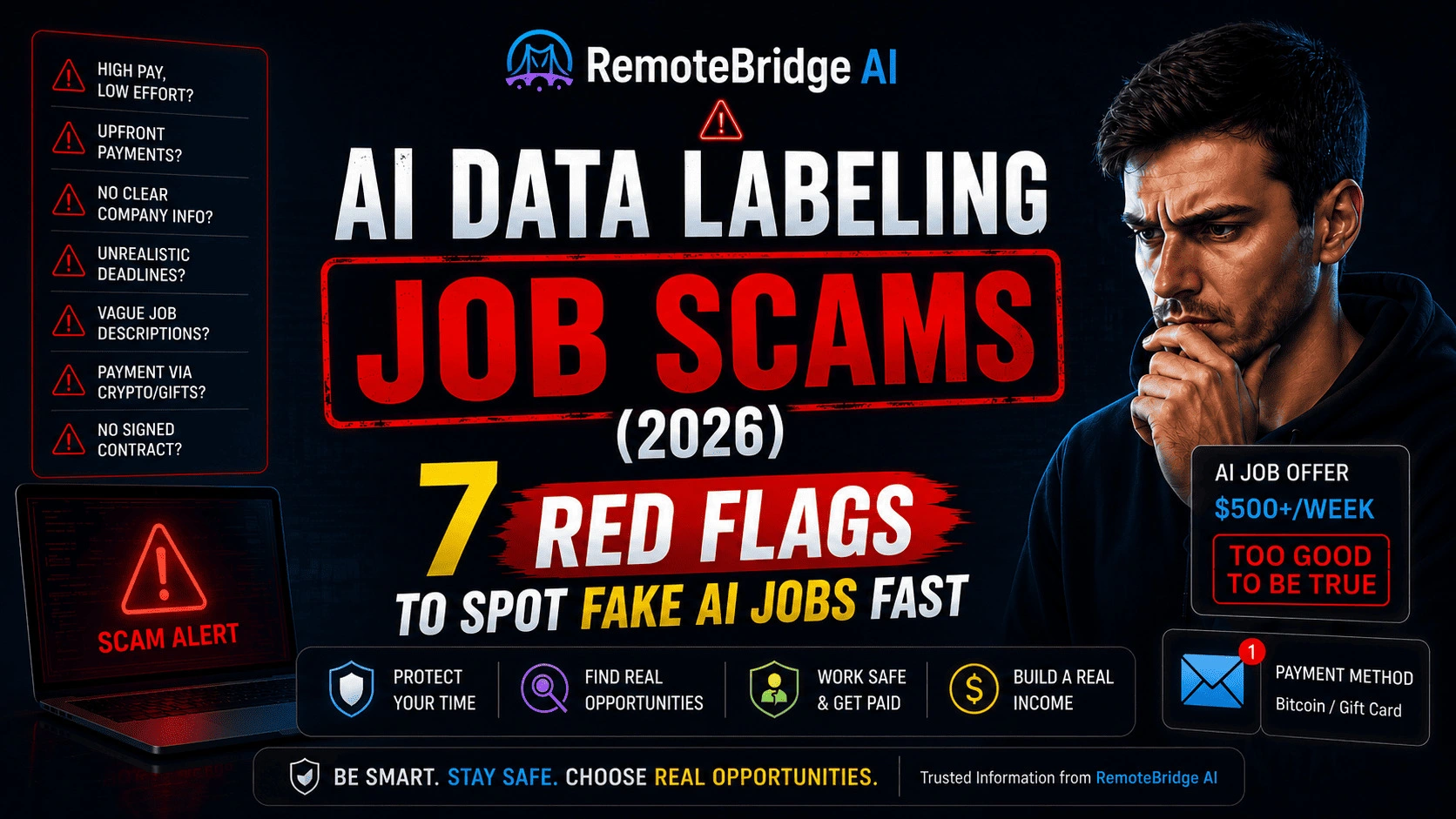
🚨 AI Data Labeling Job Scams (2026): 7 Red Flags to Spot Fake AI Jobs Fast
Last Updated: Oct, 2026
🧠 Introduction
Are AI data labeling jobs legitimate opportunities—or just another online scam?
With the rapid growth of artificial intelligence, demand for remote AI workers has increased dramatically. Unfortunately, scammers have noticed this trend too.
In 2026, fake AI job offers are becoming more sophisticated. Fraudsters copy legitimate company websites, impersonate recruiters, and use social media platforms to target job seekers looking for remote work.
The good news is that many AI data labeling jobs are completely legitimate when you apply through trusted companies.
This guide will show you how to identify scam warning signs, verify companies, protect your personal information, and safely apply for real AI jobs.
⚡ Quick Summary
Before diving deeper, remember these key points:
✅ AI data labeling jobs are legitimate
✅ Legitimate companies never charge application fees
✅ Telegram and WhatsApp recruiting is usually a warning sign
✅ Always verify the company website and email domain
✅ Apply through trusted platforms only
Rule of Thumb:
👉 If an offer sounds too good to be true, it usually is.
📚 In This Guide, You’ll Learn
- How to identify fake AI job offers quickly
- Seven major scam warning signs
- How to verify legitimate AI companies
- Real versus fake job examples
- Common beginner mistakes
- How to stay safe while applying
- Trusted platforms for AI data labeling work
🤔 Are AI Data Labeling Jobs Legit?
Yes.
AI data labeling is a real industry that helps train machine learning systems.
Common tasks include:
- Image annotation
- Text classification
- Audio labeling
- Search evaluation
- AI response evaluation
- Data categorization
Large technology companies and AI providers frequently hire remote contributors to perform these tasks.
However, scammers often impersonate legitimate employers, making it difficult for beginners to distinguish real opportunities from fraudulent ones.
👉 Read our complete guide: Are AI Remote Jobs Legit? Complete Safety Guide
🚩 Where Do AI Job Scammers Usually Find Victims?
Most scam offers do not originate from trusted hiring platforms.
Scammers frequently target workers through:
📱 Telegram Groups
Fake recruiters promise immediate hiring and unrealistic income.
💬 WhatsApp Messages
Unsolicited messages claiming urgent openings are common.
📘 Facebook Groups
Many scammers post fake remote job advertisements in large work-from-home groups.
🔗 Fake LinkedIn Profiles
Some create professional-looking profiles that imitate legitimate recruiters.
📧 Email Campaigns
Fraudsters often send mass emails claiming you’ve been selected for a high-paying position.
🌐 Fake Websites
Scam websites frequently copy the appearance of legitimate companies.
🚨 7 Red Flags of AI Job Scams
❌ 1. Upfront Fees
Legitimate employers do not charge workers for:
- Registration
- Training
- Equipment
- Security verification
If you’re asked to pay money before starting work, leave immediately.
❌ 2. Telegram or WhatsApp Hiring
Professional companies usually recruit through:
- Official websites
- Applicant tracking systems
- Corporate email accounts
Random chat messages are a major warning sign.
❌ 3. Fake Email Domains
Legitimate recruiters use company domains.
Examples:
Always inspect the email address carefully.
❌ 4. Unrealistic Income Claims
Promises such as:
- Earn $100 per hour instantly
- Make $500 daily with no experience
- Guaranteed income
are usually designed to attract victims.
Legitimate companies explain pay structures realistically.
❌ 5. No LinkedIn Presence
Most established companies maintain:
- Company pages
- Employee profiles
- Hiring announcements
If you cannot find any professional presence, investigate further.
❌ 6. No Official Website
Every legitimate AI company should have:
- Company information
- Contact details
- Privacy policy
- Terms of service
Missing information is a major warning sign.
❌ 7. Urgency Tactics
Scammers frequently use pressure:
- “Only 5 positions left”
- “Apply within 1 hour”
- “Pay today to reserve your spot”
Legitimate employers allow candidates time to evaluate opportunities.
🔍 How to Verify an AI Job Website in 60 Seconds
Before applying, perform these quick checks.
🌐 Check the Domain
Professional domains look like:
- company.com
- careers.company.com
Suspicious domains often contain:
- Extra words
- Random numbers
- Unusual extensions
📄 Check Company Information
Look for:
- Physical address
- Contact information
- Privacy policy
- Terms of service
🔗 Check LinkedIn
Verify:
- Company page
- Employee profiles
- Hiring activity
⭐ Check Independent Reviews
Search:
- Trustpilot
- Glassdoor
Look for consistent experiences from real users.
⚖️ Why Legitimate AI Companies Never Charge Application Fees
Legitimate AI companies earn revenue from clients—not workers.
Therefore, they do not require payments for:
- Applications
- Training programs
- Security deposits
- Account activation
If payment is required before work begins, treat the opportunity as suspicious.
📊 Legitimate AI Job vs Scam AI Job
| Feature | Legitimate Job | Scam Job |
|---|---|---|
| Official Website | ✅ | ❌ |
| Corporate Email | ✅ | ❌ |
| Skills Assessment | ✅ | ❌ |
| Upfront Fee | ❌ | ✅ |
| LinkedIn Presence | ✅ | ❌ |
| Real Reviews | ✅ | ❌ |
| Payment After Work | ✅ | ❌ |
| Transparent Hiring Process | ✅ | ❌ |
💰 Real vs Fake AI Job Example
✅ Legitimate Job
- Apply through official website
- Complete qualification tests
- Receive project guidelines
- Perform verified work
- Get paid after approval
❌ Scam Job
- Contact via Telegram
- Promises instant income
- Requests payment
- No screening process
- No verifiable company
💵 How Much Can You Actually Earn?
Realistic income expectations vary.
🟢 Beginner
$3–$10 per hour
🟡 Intermediate
$10–$20 per hour
🔵 Advanced
$20+ per hour
Remember:
Legitimate employers discuss realistic earnings—not guaranteed wealth.
🤖 Why AI Data Labeling Companies Still Need Human Workers
Many beginners wonder:
“If AI is so advanced, why are humans still needed?”
The answer is simple.
Humans are required to:
- Label images
- Review AI outputs
- Evaluate search results
- Categorize content
- Improve machine learning accuracy
This ongoing need creates legitimate opportunities for remote workers.
🧠 Why AI Job Scams Are Increasing
Several factors contribute to the rise of scams.
📈 Growing Demand
Remote AI work is increasingly popular.
🎯 Beginner Inexperience
Many newcomers are unfamiliar with recruitment practices.
📱 Social Media Reach
Scammers can contact thousands of users instantly.
🤖 AI Tools
Fraudsters now use AI-generated content to create convincing messages and websites.
💼 Best AI Data Labeling Platforms for Beginners (2026)
Apply only through trusted companies.
🔹 Appen Jobs Review: AI Data Labeling Opportunities & Earnings
🔹 TELUS AI Jobs Guide: Remote AI Training & Data Annotation Work
🔹 OneForma Jobs Review: AI Projects, Pay & Application Process
🔹 DataForce Jobs Guide: Remote AI Data Collection and Labeling Work
🔹 Clickworker Review: Microtasks, AI Jobs & Earnings
👉 Explore:
🔹Best AI Data Labeling Jobs for Beginners and Experienced Workers
⚠️ What To Do If You Get Scammed
If you suspect fraud:
1️⃣ Stop Communication Immediately
Do not send additional information.
2️⃣ Protect Your Accounts
Change passwords immediately.
3️⃣ Contact Financial Providers
If money was sent, notify your bank or payment provider.
4️⃣ Report the Scam
Report fraudulent activity to relevant authorities and platforms.
5️⃣ Warn Others
Sharing experiences helps protect other job seekers.
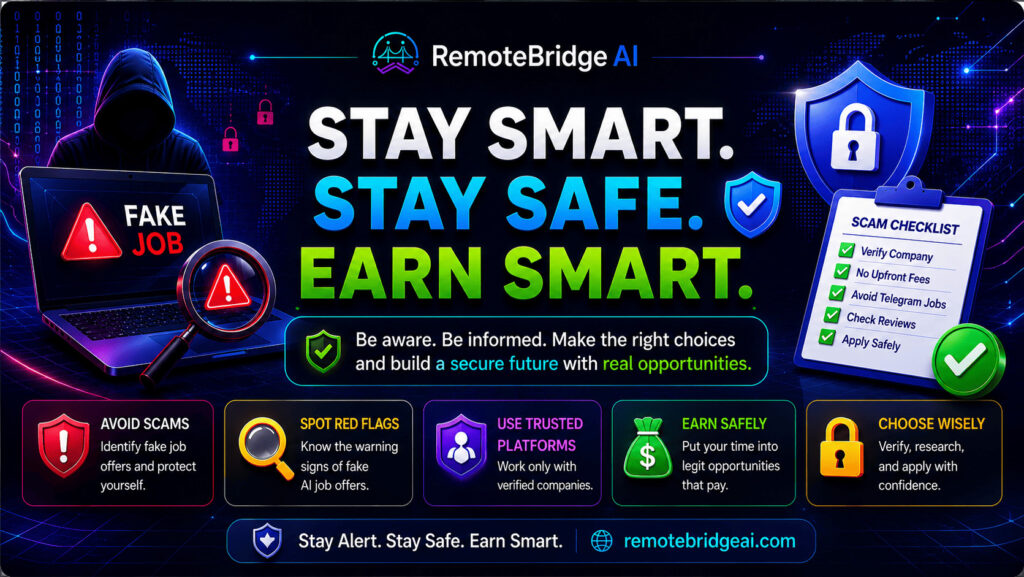
🛡️ Pro Safety Checklist
Before applying, verify:
✔ No upfront fees
✔ Official company website
✔ Corporate email address
✔ Real online reviews
✔ LinkedIn presence
✔ Clear hiring process
✔ Realistic earnings claims
✔ Transparent payment methods
📌 Common Beginner Mistakes
Avoid these common errors:
❌ Applying Without Research
Always investigate companies first.
❌ Trusting Social Media Offers
Social media alone does not verify legitimacy.
❌ Paying Upfront Fees
Legitimate employers never require payment.
❌ Ignoring Reviews
Research experiences from real users.
❌ Depending on One Platform
Diversification reduces risk.
🧩 Expert Insight
Legitimate AI companies invest heavily in:
- Worker screening
- Quality control systems
- Performance reviews
- Secure payment systems
If a company skips these processes entirely, it deserves additional scrutiny.
🎯 Final Thoughts
AI data labeling jobs are legitimate, but scams continue to increase.
The safest approach is simple:
✅ Use trusted platforms
✅ Never pay fees
✅ Verify company information
✅ Read reviews
✅ Focus on skill development
Stay alert. Stay safe. Earn smart.
👉 Related Guides:
- What Is AI Data Labeling? Complete Beginner’s Guide
- How to Start AI Data Labeling Jobs With No Experience
- Is AI Data Labeling Worth It? Pros, Cons & Real Experiences
❓ Frequently Asked Questions
Q1. Are AI data labeling jobs legit?
Yes. Many reputable companies offer legitimate AI data labeling opportunities.
Q2. Do legitimate AI jobs require payment?
No. Legitimate employers never charge workers to apply or begin work.
Q3. How can I identify AI job scams?
Watch for fake email addresses, unrealistic pay claims, missing company information, and requests for money.
Q4. Can beginners apply?
Yes. Many AI data labeling platforms welcome beginners.
Q5. Are AI data labeling jobs remote?
Most opportunities can be completed from home.
Q6. What are the most common AI job scams?
Fake job offers, upfront payment scams, account verification scams, and impersonation scams.
✍️ About RemoteBridge AI
Written by the RemoteBridge AI Team
We research, review, and test legitimate AI job platforms to help remote workers find trustworthy opportunities and avoid online scams. This guide is regularly updated to reflect the latest developments in the AI job market and emerging scam tactics.