⭐ AI Rater Jobs for Beginners (2026): How to Apply, Skills, Tests & Earnings
🗓️ Last Updated: November 2026
🚀 Introduction
What if your ability to read carefully, identify mistakes, and judge whether an answer makes sense could help improve artificial intelligence?
That is the basic idea behind AI rater jobs.
As AI tools become more capable, companies need human feedback to evaluate AI-generated answers, identify inaccurate information, compare competing responses, and determine whether a model follows instructions correctly.
AI rating is one of several remote work categories connected to AI development. Depending on the project, contributors may evaluate chatbot responses, assess search results, review generated images, test language quality, or explain why one answer is better than another.
The good news is that some AI rating projects accept applicants without previous professional experience. However, eligibility, language requirements, qualification tests, and available work vary considerably between projects.
You do not necessarily need to be a programmer. You do need to think critically, follow detailed instructions, research information carefully, and communicate your decisions clearly.
Whether you are a student, freelancer, working professional, or beginner exploring remote opportunities, this guide will help you understand how AI rating works and how to approach it realistically.
In this complete guide, you will learn:
- What AI rater jobs are and how they work.
- The difference between AI raters, AI data labelers, and AI trainers.
- The skills required to become an AI rater.
- How AI rating qualification tests work.
- How to find legitimate platforms and apply.
- How to evaluate AI answers using practical examples.
- What affects earnings and payment.
- Common application mistakes and warning signs.
- Free tools that can help you organize your remote-work journey.
- How to build experience and progress toward more specialized roles.
Let’s get started.
📚 Table of Contents
- What Are AI Rater Jobs?
- How Do AI Raters Work?
- AI Rater vs AI Data Labeler vs AI Trainer
- Types of AI Rater Jobs
- Skills You Need to Become an AI Rater
- Equipment and Setup Requirements
- Practical AI Rating Example
- How AI Rater Qualification Tests Work
- Platforms to Explore for AI Rating Jobs
- How to Apply for AI Rater Jobs Step by Step
- AI Rater Earnings and Payment
- Why AI Rater Applications Get Rejected
- How to Improve Your AI Rating Accuracy
- Common AI Rater Job Scams
- AI Rater Career Growth Path
- Free RemoteBridge AI Tools for Your Job Search
- Beginner AI Rater Readiness Checklist
- Final Thoughts
- Frequently Asked Questions
🤖 1. What Are AI Rater Jobs?
AI rater jobs involve evaluating the quality of content or responses produced by artificial intelligence systems.
An AI model can generate an answer that sounds convincing but contains incorrect facts, ignores part of a question, or fails to follow the user’s instructions.
Human raters help identify these problems.
Depending on the project, you might compare two AI-generated responses, assess the relevance of search results, check whether a statement is supported by reliable evidence, or evaluate the quality of generated content.
Your work provides structured feedback that can help improve AI systems.
What does an AI rater actually do?
Typical responsibilities include:
- Comparing two or more AI-generated responses.
- Checking answers for factual accuracy.
- Evaluating whether an answer follows instructions.
- Assessing relevance, clarity, and completeness.
- Identifying unsupported claims or misleading information.
- Rating search engine results.
- Reviewing grammar, language, and readability.
- Explaining why one response is better than another.
- Evaluating generated images, audio, or video when a project requires it.
- Following detailed evaluation guidelines and quality standards.
Not every project includes all these tasks. Some focus on language, others on research, and others on specialist knowledge.
Why do AI companies need human raters?
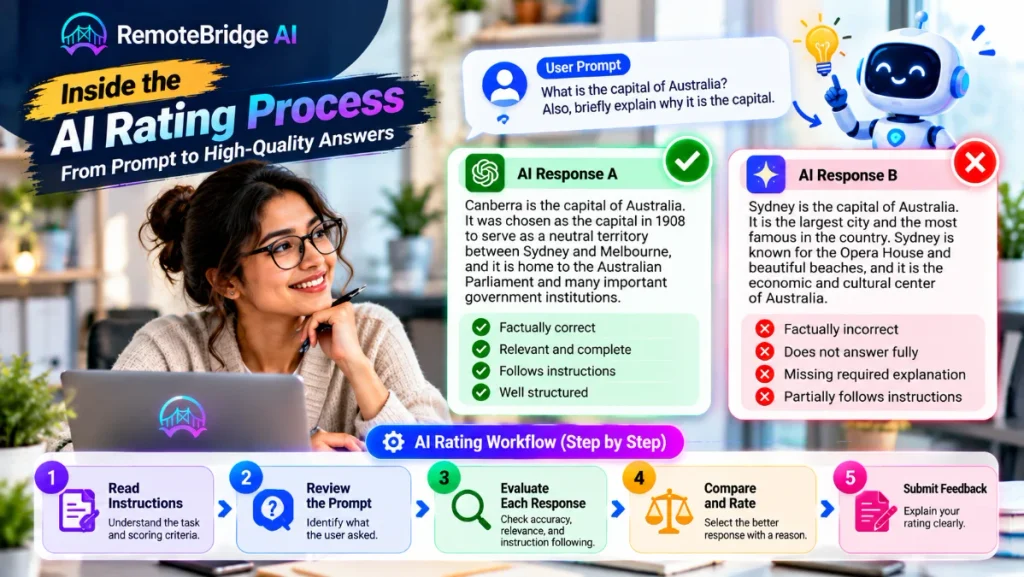
Consider a chatbot that answers this question:
Question: What is the capital of Australia?
Response A: Canberra is the capital of Australia.
Response B: Sydney is the capital of Australia.
Both responses are written clearly, but only Response A is factually correct.
An AI rating task may require you to identify this difference and assign ratings according to the project’s rules.
More complex assignments may involve comparing lengthy explanations, evaluating reasoning, checking sources, or deciding whether an answer satisfies several requirements simultaneously.
The key principle: an AI rater does not simply choose the answer that sounds better. The goal is to evaluate responses against the actual task instructions and evidence.
🔍 2. How Do AI Raters Work?
Although workflows differ across platforms, many AI rating projects follow a similar process.
A typical AI rating workflow
Step 1: Read the task instructions
Understand the scoring criteria, definitions, examples, and restrictions before beginning.
Step 2: Review the prompt
Identify what the user asked, including any format, language, factual, or safety requirements.
Step 3: Examine the AI response
Check whether the answer addresses the question, follows the instructions, and provides accurate information.
Step 4: Compare alternatives when required
Some assignments ask you to rank two or more responses based on usefulness, correctness, clarity, or other criteria.
Step 5: Assign a rating
Select the appropriate score using the project’s rubric. Do not invent your own scoring system.
Step 6: Explain your decision
Some projects require a short justification identifying the strengths or weaknesses of a response.
Step 7: Submit and review
Check your rating and explanation against the instructions before submitting the task.
What makes a good AI rating?
A good rating should be:
- Evidence-based: supported by the prompt, reliable facts, or the supplied guidelines.
- Consistent: similar responses should receive similar ratings when the criteria are the same.
- Relevant: focused on the requirements of the task.
- Clear: easy for another reviewer to understand.
- Independent: based on your own judgment and the permitted research process.
Some projects measure agreement with established reference ratings or perform ongoing quality reviews. Consistency therefore matters just as much as speed.
⚖️ 3. AI Rater vs AI Data Labeler vs AI Trainer
These terms are related, but they do not always describe the same work.
AI data labeling generally involves organizing or annotating information. AI rating focuses on judging the quality of outputs or other digital content. AI training is a broader category that can include rating, annotation, data collection, specialist feedback, and other activities.
| Feature | AI Rater | AI Data Labeler | AI Trainer |
|---|---|---|---|
| Main purpose | Evaluate quality | Label or organize data | Improve AI systems through assigned tasks |
| Typical work | Compare and score answers | Tag images, text, audio, or video | Provide feedback, evaluate outputs, or create training data |
| Core skill | Critical thinking | Accuracy and attention to detail | Depends on the project |
| Research requirements | Often useful | Project-dependent | Project-dependent |
| Writing requirements | Sometimes substantial | Often limited, but varies | Depends on the role |
| Coding required | Usually not for basic rating projects | Usually not for basic labeling projects | Depends on the position |
| Beginner access | Available on some projects | Available on some projects | Varies by role |
These are general distinctions rather than universal job classifications. A company may use different titles for similar responsibilities.
If you are new to this field, read our AI Data Labeling Jobs: Complete Beginner Guide to understand another common entry point into AI-related work.
You can also explore AI Training Jobs: Complete Guide for Beginners for a broader overview of different roles.
🧩 4. Types of AI Rater Jobs
AI rating is not a single job category. Different projects require different strengths.
⭐ 4.1 AI Response Rater
AI response raters assess how well a chatbot answers a user’s question.
Typical tasks include checking relevance, completeness, clarity, factual accuracy, and instruction-following.
Best suited for: people who enjoy reading, analyzing information, and comparing answers.
🔎 4.2 Search Quality Rater
Search quality raters assess whether search results match a user’s intent.
For example, if someone searches for “official passport application website,” a result leading to an unrelated blog may be less useful than the relevant official government page.
Depending on the project, raters may consider relevance, page quality, usefulness, and the purpose behind a search.
Best suited for: people with strong research skills and an understanding of how people search for information online.
Related guide: TELUS AI Jobs.
💬 4.3 AI Chatbot Evaluator
Chatbot evaluators examine conversational responses for helpfulness, accuracy, natural language, and adherence to instructions.
Some projects involve multi-turn conversations, meaning you must assess whether the AI maintains context across several messages.
Best suited for: people with strong reading comprehension and analytical skills.
✍️ 4.4 Language and Writing Evaluator
Language evaluators review grammar, sentence structure, tone, fluency, and whether written content sounds natural in the required language.
Some projects require native-level or professional language proficiency.
Best suited for: writers, editors, teachers, translators, and language specialists.
🧠 4.5 AI Reasoning Evaluator
Reasoning evaluators assess whether an answer reaches a defensible conclusion and whether its explanation supports that conclusion.
Tasks may involve mathematical reasoning, logical consistency, identifying contradictions, or checking whether a response addresses every part of a problem.
Some specialist projects require advanced education or subject expertise.
Best suited for: analytical thinkers and applicants with relevant academic or professional knowledge.
🖼️ 4.6 AI Image and Video Evaluator
These projects involve evaluating generated visual content.
You might check whether an image follows a prompt, whether objects appear distorted, whether text in an image is correct, or whether a video contains visual inconsistencies.
Best suited for: people with strong visual observation skills and patience.
🛡️ 4.7 AI Safety and Content Evaluator
Some projects assess whether AI-generated content follows defined safety, policy, or quality requirements.
Tasks may involve identifying harmful instructions, inappropriate content, misleading claims, or policy violations.
These projects can require specialized training and may expose contributors to sensitive material.
Best suited for: people who can apply rules consistently and make careful judgments.
📊 Quick comparison
| Role | Primary skill | Typical challenge |
|---|---|---|
| AI Response Rater | Critical thinking | Comparing answer quality |
| Search Quality Rater | Research | Understanding search intent |
| Chatbot Evaluator | Context analysis | Reviewing multi-turn conversations |
| Language Evaluator | Language proficiency | Identifying subtle language problems |
| Reasoning Evaluator | Logic | Checking complex conclusions |
| Visual Evaluator | Observation | Detecting small visual errors |
| Safety Evaluator | Policy interpretation | Applying detailed rules consistently |
There is no universally easiest role. The best starting point depends on your language ability, experience, interests, and the requirements of available projects.
🧠 5. Skills You Need to Become an AI Rater
You do not necessarily need a technical degree to qualify for an entry-level AI rating project. However, you should be prepared to demonstrate the specific skills requested in the job description.
📖 Reading comprehension
You must understand what a prompt asks before judging the response.
A small misunderstanding can lead to an incorrect rating even when your general knowledge is strong.
How to improve: summarize the user’s request in one sentence before evaluating the answer.
🔍 Attention to detail
AI responses can contain small but important errors, such as incorrect dates, missing conditions, unsupported statistics, or contradictory statements.
How to improve: check factual claims, names, numbers, units, and instructions systematically.
💭 Critical thinking
A confident-sounding answer is not necessarily a correct answer.
You need to separate writing quality from factual accuracy and distinguish relevant explanations from unnecessary detail.
How to improve: ask whether the answer is correct, relevant, complete, and supported by evidence.
🌐 Research and verification
Some tasks require independent research. In those cases, you should know how to locate authoritative sources and verify claims.
How to improve: prioritize official documentation, original research, and reputable sources appropriate to the topic.
✍️ Clear writing
When a task requires a justification, your explanation should identify the actual problem rather than simply saying that one response is better.
Weak justification: “Response A is better.”
Stronger justification: “Response A directly answers the question and gives the correct date, while Response B includes an incorrect date.”
The second explanation identifies the reason for the judgment.
📋 Ability to follow guidelines
Every project can have different scoring rules. A rating that works for one task may be inappropriate for another.
How to improve: study examples, understand borderline cases, and refer back to the rubric when uncertain.
For additional preparation, read our AI Job Skills for Beginners.
💻 6. Equipment and Setup Requirements
Most browser-based AI rating projects require a straightforward home-office setup.
| Requirement | Recommendation |
|---|---|
| Computer | Reliable laptop or desktop |
| Internet | Stable connection |
| Browser | Current version of a supported browser |
| Active email account | |
| Workspace | Comfortable, reasonably quiet environment |
| Headphones | Useful or required for audio tasks |
| Smartphone | May be required for verification or specific projects |
| Payment method | A method supported by the platform and your location |
Some projects require particular operating systems, minimum hardware specifications, identity verification, or additional software.
Do not assume that every AI rating job can be completed on a smartphone. Check the requirements before applying.
Read our AI Data Labeling Setup Guide for more preparation advice.
🧪 7. Practical AI Rating Example
One of the best ways to understand AI rating is to examine a simple example.
Imagine that a user asks:
Prompt: “Give me three practical ways to reduce electricity use at home.”
Response A:
- Switch off lights when they are not needed.
- Use energy-efficient lighting.
- Turn off electronic devices when they are not in use.
Response B:
- Leave lights switched on throughout the day.
- Replace efficient bulbs with less efficient ones.
- Keep unnecessary electronic devices running.
How should you evaluate these responses?
| Evaluation criterion | Response A | Response B |
|---|---|---|
| Relevance | High | Relevant to the topic but poor advice |
| Practical usefulness | High | Low |
| Factual soundness | Generally sound | Recommends wasteful practices |
| Instruction-following | Provides three suggestions | Provides three suggestions |
| Overall assessment | Stronger | Weaker |
Response A is the stronger answer because its suggestions align with the user’s goal.
Notice something important: both responses follow the requested format and contain three suggestions. However, format compliance alone does not make a response good.
An evaluator must consider the actual scoring criteria rather than awarding a high rating simply because an answer looks organized.
A more difficult example
Suppose two answers provide similar advice, but one includes an unsupported claim that a particular action will reduce electricity bills by exactly 40%.
The second answer may be more detailed, but that does not automatically make it better.
You should check whether the numerical claim is supported and apply the project’s accuracy criteria.
Practical lesson: evaluate what the answer actually says, not just how confidently or elegantly it is written.
The examples in this section are educational illustrations, not official qualification-test questions from any company.
📝 8. How AI Rater Qualification Tests Work
Some AI rating opportunities require assessments before you can begin paid work.
The exact process varies by provider and project.
Stage 1: Application screening
The company may review your location, language proficiency, education, experience, or other eligibility criteria.
Some roles require professional qualifications, while others focus on general language and analytical skills.
Stage 2: Guidelines and training materials
You may receive instructions explaining the rating scale, evaluation categories, and examples of acceptable decisions.
Read these materials carefully. Do not assume that a scoring system from another platform applies.
Stage 3: Qualification assessment
An assessment may ask you to evaluate sample responses, apply a rubric, identify factual errors, or provide written explanations.
Some projects use timed assessments; others have different formats.
Stage 4: Review and onboarding
The company may evaluate your assessment before providing onboarding instructions or project access.
Passing an assessment does not guarantee immediate paid work. Project availability and other eligibility requirements may still apply.
How to prepare for an AI rating test
1. Understand the instructions first.
Identify what each rating category means and how the company expects you to handle uncertain cases.
2. Separate facts from opinions.
An answer can be well-written but factually wrong. It can also be accurate but poorly organized.
3. Read the complete response.
Do not rate an answer based only on its first sentence.
4. Check important claims.
When research is allowed, verify claims using reliable sources.
5. Explain your reasoning clearly.
If written justification is required, identify specific evidence or errors.
6. Follow assessment rules.
Use only the tools and resources permitted by the provider. Some assessments prohibit outside assistance or AI tools.
7. Prioritize accuracy over rushing.
Speed is useful only when your judgments remain consistent and correct.
For more qualification preparation, see TELUS AI Exam Tips.
🏢 9. Platforms to Explore for AI Rating Jobs
The following organizations provide or have provided AI-related evaluation, rating, or training-data opportunities. Their project types are not identical, and availability changes over time.
Always check the current official listing before applying. A company offering AI-related work does not necessarily have an open beginner-friendly rating project in your country.
1. TELUS Digital AI Community
TELUS Digital lists AI Community opportunities that can include rating, search evaluation, content evaluation, and data-related work.
Eligibility may depend on language, country, residence history, experience, and project requirements.
Official opportunities: https://www.telusdigital.com/careers/ai-community
Related guide: TELUS AI Jobs.
2. Outlier
Outlier offers AI-related projects that can involve evaluating responses, providing feedback, and contributing subject-matter expertise.
Some projects are designed for generalist contributors, while others require specialist skills or particular language abilities.
Applications, assessments, rates, and task availability vary by opportunity.
Official opportunities: https://outlier.ai/
Related guide: Outlier AI Jobs.
3. RWS TrainAI
RWS TrainAI connects contributors with AI data projects. Its work categories can include online rating, search engine evaluation, annotation, and data collection.
The required language, location, and qualifications depend on the project.
Official community information: https://www.rws.com/artificial-intelligence/train-ai-data-services/trainai-community/
4. OneForma
OneForma provides project-based opportunities involving AI data, language work, annotation, and related tasks. Some projects may involve evaluation activities, depending on current requirements.
Check the project description rather than assuming all listings involve AI rating.
Official website: https://www.oneforma.com/
Related guide: OneForma Jobs.
5. Appen / CrowdGen
Appen’s CrowdGen platform offers AI-related project opportunities that may include data annotation, evaluation, and other forms of contributor work.
The exact role, payment terms, and eligibility requirements depend on the listing.
Official platform: https://crowdgen.com/
Related guide: CrowdGen Review.
6. Clickworker
Clickworker offers online microtasks, with the type of work depending on current projects and contributor eligibility. Some tasks may be relevant to AI data or evaluation workflows.
Do not assume that registering guarantees access to AI rating work.
Official website: https://www.clickworker.com/
Related guide: Clickworker Jobs.
Quick platform comparison
| Platform | Relevant work to investigate | What to verify |
|---|---|---|
| TELUS Digital | Search and AI content evaluation | Location and language requirements |
| Outlier | AI response evaluation and feedback | Skills, assessment, project availability |
| RWS TrainAI | Online rating and search evaluation | Current project eligibility |
| OneForma | AI and language-related projects | Specific project responsibilities |
| CrowdGen | AI evaluation and data projects | Current listings and payment terms |
| Clickworker | Online microtasks and selected AI-related tasks | Whether rating work is available |
These are starting points for research, not a ranking of the platforms or a guarantee that any one of them is currently accepting every applicant.
Before committing time to an application, compare the requirements with your skills and location.
To compare platform features and explore available options, you can also use the RemoteBridge AI Compare AI Platforms tool.
🚀 10. How to Apply for AI Rater Jobs Step by Step
A structured application process can help you avoid wasting time on unsuitable opportunities.
Step 1: Choose your strongest skill area
Decide whether your strengths are in language, research, writing, general reasoning, mathematics, or visual evaluation.
Start with roles that match your existing abilities.
Step 2: Check eligibility before registering
Read the job description for:
- Supported countries and languages.
- Education or experience requirements.
- Computer and internet requirements.
- Assessment procedures.
- Expected availability.
- Payment conditions.
- Contractor or employment status.
Do not spend hours preparing for a role that excludes your location.
Use the RemoteBridge AI Country Availability tool to help organize your country-eligibility research. Always confirm eligibility against the provider’s official listing.
Step 3: Find suitable opportunities
Do not rely on a single platform or assume that every AI-related job is suitable for you.
Start with a few relevant providers, examine their requirements, and compare the available opportunities.
The RemoteBridge AI Smart Finder can help you explore platform options based on your preferences.
For additional platform research, explore:
These resources can support your research into platform information, evidence, and status. Check their displayed information and the official provider’s website before making an application decision.
Step 4: Prepare your resume
You do not need to invent AI work experience if you are a beginner.
Instead, emphasize transferable skills such as:
- Research and fact-checking.
- Reading comprehension.
- Written communication.
- Quality assurance.
- Data accuracy.
- Analytical problem-solving.
- Language proficiency.
- Following documented procedures.
For example, experience reviewing reports, checking spreadsheets, editing documents, or validating information may demonstrate relevant skills when described honestly.
Use the RemoteBridge AI Resume Builder to help prepare your resume.
You can also use the Job Keyword Checker to identify relevant terms from a job description and assess whether your resume reflects your genuine skills and experience.
Step 5: Identify skill gaps
If a role requires stronger research, writing, language, or analytical skills, identify what you need to improve before applying.
The Skill Gap & AI Readiness tool can help you examine skills and preparation areas.
The Remote Work Readiness tool can help you assess your broader preparation for remote work.
Step 6: Create your account through the official website
Use the company’s verified application portal.
Provide accurate information and complete any required verification steps. Never create multiple accounts if the platform prohibits them.
Step 7: Complete the assessment honestly
Study the supplied guidelines and follow the assessment rules.
If the company prohibits external help or AI-generated answers, respect that restriction. Your application should demonstrate your own ability.
Step 8: Complete onboarding
If selected, review the contract, payment arrangements, confidentiality requirements, and task instructions.
Understand how completed work is measured and what conditions apply to payment.
Step 9: Track applications and follow up appropriately
Maintain a simple record of the platform, application date, role, assessment status, and any response received.
The Application Follow-Up Planner can help you organize application dates, follow-ups, and next actions.
Avoid submitting repeated applications that violate a provider’s rules.
Step 10: Keep exploring suitable opportunities
Project-based work may be irregular. You can investigate other legitimate platforms while remaining within each provider’s account and contract rules.
The Remote Work Pathway Builder can help you map possible next steps based on your interests, skills, and goals.
Read our guide to Why You Are Not Getting AI Jobs if you need help troubleshooting your job search.
💰 11. AI Rater Earnings and Payment
One of the most common questions is: How much can an AI rater earn?
There is no single reliable earning figure for all AI raters.
Payment depends on the project, country, language, expertise, task complexity, and payment arrangement.
Some opportunities advertise hourly rates, while others compensate contributors according to completed tasks or another defined method.
What determines AI rater earnings?
| Factor | Why it matters |
|---|---|
| Project type | Specialist evaluation may have different rates from general rating |
| Language | Demand and project requirements vary by language |
| Country | Rates and eligibility may differ by location |
| Expertise | Some technical or professional projects require advanced knowledge |
| Paid task availability | Registration does not guarantee a steady workload |
| Assessment results | Some projects require qualification before paid work begins |
| Payment model | Hourly, task-based, and other arrangements affect earnings |
| Unpaid time | Training, assessments, and waiting periods can affect your effective hourly return |
Advertised rate versus actual earnings
Imagine that a project advertises a rate of $10 per paid hour.
If you complete two paid hours, your gross project earnings would be $20.
However, this calculation does not tell you how many hours of work will be available, whether the rate applies to every task, or how much time you may spend on unpaid onboarding.
Always check the specific contract and payment terms.
You can use the RemoteBridge AI Earnings Calculator to estimate earnings using your own assumptions.
The Earnings Insights tool can help you explore earnings-related information, while the Freelance Rate Calculator can help you consider your target rate and working time when planning freelance work.
These tools support planning; they cannot guarantee the amount of work a platform will offer.
For a broader discussion of AI-related work compensation, read our AI Data Labeling Salary Guide.
What about payment methods?
Depending on the provider and country, payment may be processed through supported digital payment services or other approved methods.
Before starting, verify:
- Minimum payout requirements.
- Payment frequency.
- Supported payment methods in your country.
- Currency and conversion charges.
- Any applicable transaction fees.
- Conditions for approved or rejected work.
- Tax and reporting responsibilities that apply to you.
The Currency & Fee Calculator can help you estimate currency conversions and applicable fee scenarios using the figures you enter.
Never treat a platform’s advertised maximum rate as a guaranteed income.
⚠️ 12. Why AI Rater Applications Get Rejected
A rejected application does not always mean you lack the ability to do the work.
There can be several reasons an application or assessment does not progress.
Common reasons
1. Location restrictions
The project may not accept applicants from your country or region.
2. Language mismatch
A role may require a particular level of proficiency or familiarity with local language and culture.
3. Assessment performance
Your answers may not meet the project’s accuracy or consistency standards.
4. Incomplete application
Missing information or unfinished verification steps can prevent an application from progressing.
5. Experience or qualification requirements
Some positions require a degree, specialist knowledge, or professional experience.
6. Project capacity
A provider may pause recruitment or have limited places even when applicants meet the basic requirements.
7. Inconsistent application information
Incorrect or conflicting information can cause problems during screening or verification.
What should you do after rejection?
- Review any feedback the platform provides.
- Check whether the position has specific eligibility requirements.
- Improve the skills identified in the assessment, if feedback is available.
- Apply to other suitable projects instead of repeatedly submitting the same application.
- Use the official support channel when you believe a technical issue occurred.
Avoid paying someone who promises to secure approval or bypass a qualification test.
Related reading: Why Beginners Fail AI Labeling Jobs.
🎯 13. How to Improve Your AI Rating Accuracy
Accuracy is more valuable than rushing through a task without understanding it.
The following habits can help you approach evaluation work more systematically.
Use a repeatable review checklist
Before submitting a rating, ask:
- Did I understand the complete prompt?
- Did I identify all the user’s requirements?
- Does the response answer the actual question?
- Are important factual claims correct?
- Does the answer follow the requested format?
- Is important information missing?
- Does my rating match the project’s rubric?
- Can I explain my decision using specific evidence?
Not every project uses these exact criteria, so adapt the checklist to the supplied guidelines.
Separate different quality dimensions
A response can be strong in one area and weak in another.
| Quality dimension | Question to ask |
|---|---|
| Accuracy | Are the factual claims correct? |
| Relevance | Does the answer address the user’s question? |
| Completeness | Does it cover the important requirements? |
| Clarity | Is the answer understandable? |
| Instruction-following | Does it obey the specified constraints? |
| Evidence | Are important claims adequately supported? |
Use the criteria that apply to your assignment rather than assuming every task uses the same scoring categories.
Learn to identify uncertainty
If you cannot verify a claim, do not automatically mark it as true.
Follow the project’s rules for uncertain, ambiguous, or unverifiable information. Some tasks may require research; others may provide a fixed set of materials.
Avoid confirmation bias
Do not favor a response just because it agrees with your personal opinion.
Evaluate the evidence and the task requirements, not whether you personally like the answer.
Improve your productivity without sacrificing quality
AI rating work can involve long periods of concentration. Develop a manageable schedule, take breaks when needed, and avoid rushing just to complete more tasks.
You can use the Focus Timer to structure focused work sessions.
The Time Zone Planner can help when you need to coordinate schedules across time zones, and the Working Days & Deadline Calculator can help estimate working-day deadlines.
For additional productivity support, explore the Word & Character Counter and Text Cleaner. These can be useful for checking text length and cleaning text where permitted. Always follow platform rules about copying, transferring, and processing task content.
For broader work planning, visit the Remote Work Dashboard and Free Remote Work Tools.
These tools are optional aids. Use them only when they fit your workflow and do not conflict with a platform’s confidentiality or assessment requirements.
For more advice on developing productive habits, see Successful AI Data Labelers.
🛡️ 14. Common AI Rater Job Scams
AI-related job searches can attract misleading advertisements and impersonation attempts.
A professional-looking website or a large advertised payment does not automatically establish that an opportunity is legitimate.
Warning signs to recognize
Upfront payment requests
Be cautious if someone demands money to guarantee employment, approval, or access to a supposed private project.
Guaranteed earnings
Claims of guaranteed daily income without explaining task availability, eligibility, and payment conditions deserve scrutiny.
Unofficial recruitment messages
Verify unexpected offers through the company’s official careers website.
Requests for passwords or verification codes
Never disclose account passwords or one-time verification codes to recruiters.
Pressure to act immediately
Be careful if someone insists you pay or share sensitive information before you can review the terms.
Unclear payment conditions
Understand who is paying you, how work is approved, and what rules govern payment.
How to verify an opportunity
- Locate the company’s official website independently.
- Find the relevant job listing or contributor portal.
- Confirm that the role exists and matches the recruitment message.
- Review the eligibility and payment terms.
- Avoid paying unofficial intermediaries for guaranteed selection.
- Protect personal documents and account credentials.
You can use the RemoteBridge AI Scam Checker as an additional step when assessing suspicious job claims, messages, or websites.
The checker is a supporting tool, not a guarantee that an opportunity is safe. Independently verify the employer, official listing, and payment arrangements.
You can also consult Platform Evidence and Platform Updates for relevant platform research and updates available on RemoteBridge AI.
Read our AI Data Labeling Job Scams guide and AI Remote Jobs: Legit or Scam? before accepting an unfamiliar opportunity.
📈 15. AI Rater Career Growth Path
AI rating can help you develop useful skills in research, evaluation, quality assurance, and written analysis.
However, project-based rating work does not automatically lead to a permanent job or promotion.
A possible skill-development path is:
Beginner → AI Rater → Experienced Evaluator → Quality Reviewer → Specialist Evaluator → AI Quality or Project Operations Role
Your actual progression depends on your skills, experience, qualifications, available positions, and the requirements of the organizations you work with.
Stage 1: Beginner
Learn how to interpret prompts, apply evaluation guidelines, and identify common response-quality problems.
Stage 2: Experienced Evaluator
Develop consistency, improve your research methods, and learn to handle more complex evaluation tasks.
Stage 3: Quality Reviewer
Some organizations offer review roles involving checking other contributors’ work, resolving disagreements, or identifying recurring quality problems. These positions may require experience and additional qualifications.
Stage 4: Specialist Evaluator
If you have expertise in fields such as mathematics, software development, finance, medicine, law, or languages, you may qualify for certain specialist projects.
These roles often have stricter requirements and should not be assumed to be available to every contributor.
Stage 5: Broader AI Quality Opportunities
Skills developed through evaluation may be relevant to quality assurance, content evaluation, data operations, or AI project coordination roles.
Use the Opportunity Fit Checker to help assess how a particular opportunity aligns with your skills and preferences.
When comparing several options, the Opportunity Comparison Scorecard can help you evaluate factors such as requirements, flexibility, and other criteria that matter to you.
For a structured development plan, revisit the Remote Work Pathway Builder.
For broader career preparation, explore Highest Paying AI Data Labeling Jobs and Increase AI Data Labeling Earnings.
🧰 16. Free RemoteBridge AI Tools for Your Job Search
Finding AI rating opportunities is only one part of preparing for remote work. You may also need to compare platforms, verify claims, prepare your resume, estimate earnings, track applications, and manage your time.
RemoteBridge AI provides a collection of tools and resources designed to support different stages of this process.
🔎 Discover and research opportunities
Explore platform options based on your preferences and requirements.
Compare platform information to help narrow down options worth investigating.
Explore the recommended-platform resource and review the information provided.
Consult the available platform information and metadata.
Explore supporting evidence and research information about platforms.
Check the platform-status information provided by RemoteBridge AI.
Review available platform updates and related information.
These resources can help organize your research. Always verify important claims, recruitment status, and eligibility on the relevant provider’s official website.
🌍 Check availability and avoid suspicious offers
Use the country-availability resource to help investigate geographic eligibility.
Use the scam-checking tool as an additional step when examining suspicious opportunities.
Neither tool replaces official eligibility checks or independent verification.
💰 Plan your earnings and rates
Explore earnings-related information available through the tool.
Estimate potential earnings using your own assumptions.
Explore rate calculations when planning freelance work.
Estimate currency conversion and fee scenarios.
Remember that estimates depend on the information you enter. They do not predict the amount of paid work a provider will offer.
📄 Prepare your application
Prepare a resume that presents your real skills, experience, and qualifications.
Review relevant keywords from job descriptions and check how they relate to your resume.
Identify areas to develop as you prepare for AI-related opportunities.
Review your general preparation for remote work.
Assess whether a particular opportunity matches your needs and preferences.
Opportunity Comparison Scorecard
Compare potential opportunities using criteria relevant to your decision.
Explore possible next steps based on your goals and development priorities.
📅 Organize your work and applications
Keep track of application dates, follow-ups, and next actions.
Use the dashboard resource to organize your remote-work activities.
Plan schedules when working with teams or projects across time zones.
Working Days & Deadline Calculator
Estimate working-day deadlines and plan around relevant dates.
Structure focused work sessions and breaks.
✍️ Improve text and everyday productivity
Count words and characters when preparing permitted text.
Clean and organize text for appropriate writing tasks.
Explore the wider collection of RemoteBridge AI tools in one place.
Use these resources when they help you work more efficiently. Do not enter confidential task content, personal information, or protected project data into a tool unless the provider’s rules and the tool’s privacy practices permit it.
📚 Explore more guides
Visit Guides & Tutorials for additional learning resources.
You can also browse the Articles library to discover more RemoteBridge AI guides.
A practical tip: you do not need to use every tool at once. Start with platform research, check eligibility, prepare your resume, and track your applications. Add other tools when you have a specific need.
✅ 17. Beginner AI Rater Readiness Checklist
Before applying, use this checklist to assess your preparation.
- I can understand detailed written instructions.
- I can compare two answers objectively.
- I can identify obvious factual errors.
- I can explain a decision clearly.
- I can research claims when the task permits it.
- I can follow a scoring rubric consistently.
- I have a reliable computer and internet connection if required.
- I have checked the project’s country and language eligibility.
- I understand the assessment and payment conditions.
- I have verified the application website.
- I understand that task availability and income may vary.
- I have identified the skills I need to improve.
- I have a simple method for tracking applications and follow-ups.
You do not need to be perfect before exploring opportunities. Use this checklist to identify the areas you need to strengthen.
🎯 18. Final Thoughts
AI rater jobs offer one possible way to participate in the growing field of AI development without necessarily becoming a programmer.
The work can involve much more than selecting the better of two answers. Depending on the project, you may need to research facts, interpret detailed guidelines, recognize subtle errors, and explain your decisions consistently.
If you are a beginner, start by identifying your strongest skills, finding opportunities that match your location and qualifications, and preparing carefully for assessments.
Do not focus exclusively on advertised pay rates. Consider the actual work, task availability, payment terms, and time required to qualify.
Use RemoteBridge AI’s research resources to compare potential platforms, its application tools to prepare your resume, and its planning tools to organize your progress. Treat these resources as decision-support tools, not guarantees of employment or earnings.
Most importantly, remember that registration is not the same as selection, and selection is not a guarantee of continuous work.
Build your skills, apply through official channels, and treat each opportunity as a chance to develop experience rather than a promise of income.
❓ 19. Frequently Asked Questions
Q1. What are AI rater jobs?
AI rater jobs involve evaluating AI-generated responses, search results, or other content according to specific quality guidelines. The exact responsibilities depend on the project.
Q2. Can beginners apply for AI rater jobs without experience?
Yes, some projects accept applicants without previous professional rating experience. Others require specialist knowledge, relevant qualifications, or prior evaluation experience.
Q3. Do AI raters need coding skills?
Many general AI rating projects do not require programming. However, technical evaluation roles may require coding, mathematics, or other specialist skills.
Q4. Which companies offer AI rater opportunities?
Organizations to investigate include TELUS Digital, Outlier, RWS TrainAI, and other AI data service providers. The availability of suitable positions varies by country and project.
Q5. Are AI rater jobs available in India?
Some AI-related evaluation opportunities are advertised for applicants in India. However, eligibility depends on the individual listing, including its language, location, experience, and other requirements.
Q6. How much do AI raters earn?
There is no universal rate. Earnings depend on the project, payment model, skills required, location, and amount of paid work available. Always check the current listing and contract.
Q7. Do AI rater jobs require an interview?
Some projects use application screening and qualification assessments. Others may include interviews or additional onboarding. The process varies by provider.
Q8. Is passing the qualification test enough to guarantee work?
No. Passing an assessment does not necessarily guarantee project access, continuous tasks, or a particular income. Other eligibility and project-capacity conditions may apply.
Q9. Can I work for multiple AI rating platforms?
You may be able to work with multiple providers, subject to each platform’s rules, contractual obligations, confidentiality requirements, and any restrictions on overlapping projects.
Q10. Can I use ChatGPT during AI rating tasks?
Only when the project explicitly permits it. Some assignments prohibit AI assistance or require independent judgments. Always follow the provider’s assessment, confidentiality, and data-handling rules.
Q11. Are AI rater jobs full-time or part-time?
Both arrangements may exist, but many contributor opportunities are freelance, contract-based, or project-dependent. Check the actual role description instead of assuming a fixed schedule.
Q12. How can I avoid AI rater job scams?
Apply through official websites, verify recruiters independently, review payment terms, and avoid anyone demanding money in exchange for guaranteed selection. Never share passwords or verification codes.
Q13. Is AI rating a good long-term career?
It can help develop useful analytical and evaluation skills. However, project availability, income stability, and career progression vary. Consider building transferable skills and exploring multiple relevant career paths.
Q14. What is the difference between an AI rater and a search quality evaluator?
AI raters may evaluate AI-generated responses and other outputs, while search quality evaluators focus on the usefulness and relevance of search results. Responsibilities can overlap depending on the provider.
Q15. How should beginners prepare before applying?
Start by understanding common AI evaluation tasks, improving reading comprehension and research skills, practicing objective comparisons, and reviewing the specific eligibility requirements of legitimate projects.
Q16. Which RemoteBridge AI tools should beginners use first?
Start with Smart Finder and Compare AI Platforms to research options, Country Availability to investigate eligibility, Resume Builder to prepare your application, and Application Follow-Up Planner to organize your progress. Use other tools when a specific need arises.
Q17. Can RemoteBridge AI tools guarantee that I will get an AI rater job?
No. These tools are intended to support research, preparation, comparison, and planning. Hiring decisions, assessments, eligibility, and project availability remain under the control of the relevant provider.
Q18. Where can I find more remote-work guides?
Visit Guides & Tutorials and the Articles library for additional RemoteBridge AI resources.
👤 About the Author
The RemoteBridge AI Team researches AI training jobs, AI data labeling platforms, and remote work opportunities. Our goal is to help readers understand platform requirements, recognize potential risks, and make informed decisions through practical, beginner-friendly guides.
Learn more:
Editorial note: Platform availability, qualification requirements, and payment terms can change. Verify current information on the provider’s official website before applying.